How Time Works in Crete
On rhythm, patience, and how the hours really run in Crete
Time in Crete doesn't behave the way it does elsewhere. That's not a romantic observation; it's a practical one. Appointments are approximate. Meals run long. Conversations that should take minutes take hours. If you arrive expecting a little Mediterranean charm, you'll find something more unsettling: people here really do understand and use time differently. I've spent years traveling around the island, and I'm still adjusting.
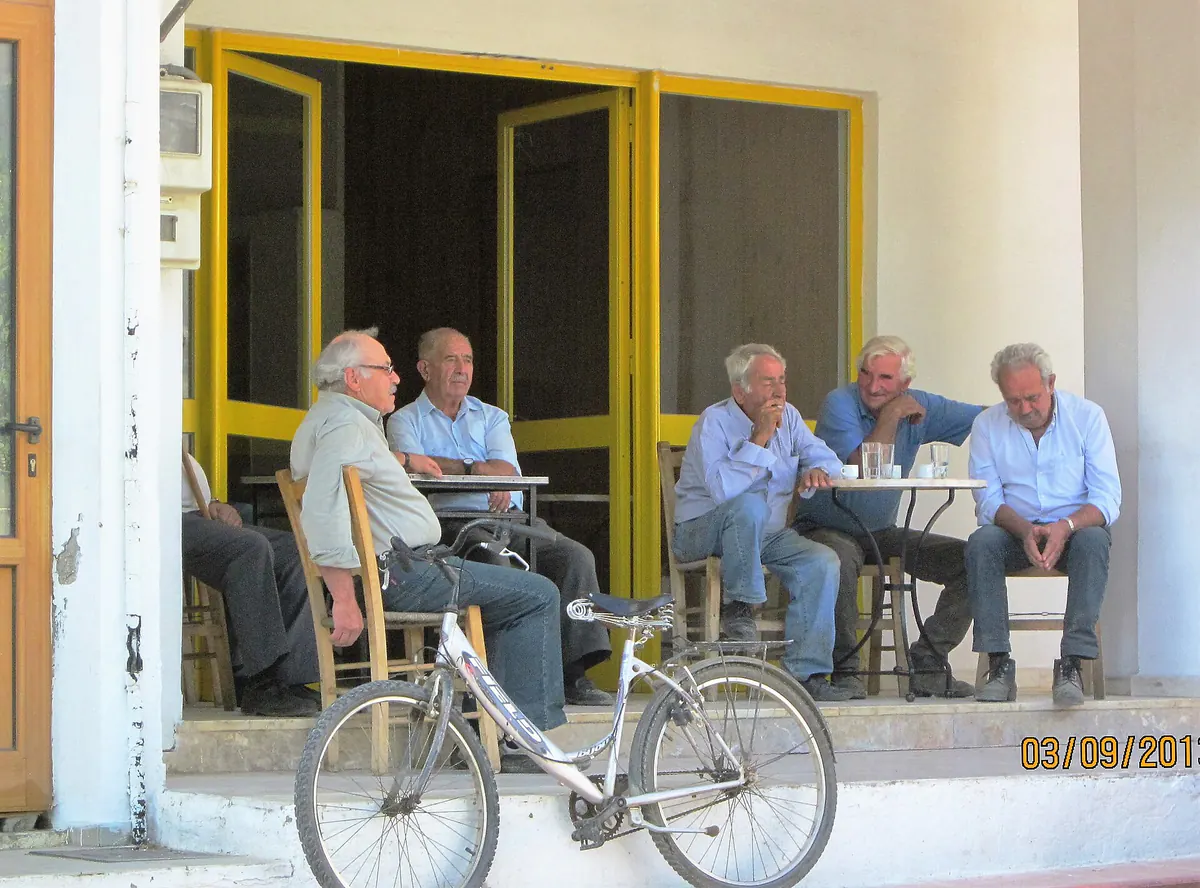
Part of the reason is practical. Even now, Crete's economy keeps farming rhythms. Work follows the seasons and the weather, not the clock. The olive harvest happens when the olives are ready, not when the calendar says so. Summer heat makes midday labor impractical, pushing activity into the early morning and the evening. These patterns hold even among people who no longer farm.
But practicality explains only part of it. There's also a cultural lean toward being present over being efficient. A conversation isn't something to wrap up but something to settle into. A meal isn't fuel but an occasion. That can frustrate visitors used to quick, businesslike exchanges, and it can also show you how thin those exchanges were. It showed me.
The Shape of the Day
The Cretan day has a shape of its own. Morning starts early, often before sunrise for anyone with farm work or animals to look after. Coffee (Greek coffee, made slowly) marks the move from private to public time. By mid-morning, kafeneia fill with men who seem to be doing nothing but are in fact keeping up the friendships and favors that make village life work.
Midday brings the mesimeri, the long afternoon pause that visitors mistake for a siesta. It's less about sleep than about getting out of the sun and putting public life on hold. Shops close. Streets empty. The whole island goes quiet, and that quiet can last from one o'clock until five or six in the evening.
Evening is when public life really begins. The volta, the evening stroll, brings families out to waterfronts and squares. Dinner comes late, often after nine, and can run until midnight. The night isn't just the absence of day; it has business of its own.
Working With the Hours
First, the literal clock: Crete keeps the same time as the rest of Greece, Eastern European Time, which is two hours ahead of UTC (UTC+2) in winter. From late March to late October the island moves to Eastern European Summer Time, three hours ahead of UTC (UTC+3), on the standard EU daylight-saving dates: the clocks go forward on the last Sunday of March and back on the last Sunday of October. In practice that puts Crete one hour ahead of the UK and Ireland year-round, and one hour ahead of most of continental Europe. Worth remembering when you book a call home, a flight, or a ferry. (If the call is a work call, my advice is to book the ferry.)
That shape has a practical side worth planning around. In the traditional pattern, local shops open at roughly 9:00 a.m. and close again around 1:30 or 2:00 p.m.; the hours between about 2:00 and 5:30 p.m. belong to lunch and the afternoon pause, and only on Tuesday, Thursday, and Friday do many reopen in the evening, roughly 6:00 to 9:00 p.m. On Sundays and public holidays, most shops that don't live off tourists stay closed altogether. Times drift by town and season, and tourist-strip shops and supermarkets keep longer, more regular hours, but the rhythm is reliable enough to plan by. (West Crete travel guide, typical hours, checked July 2026.)
For a visitor, this means treating the day as two working blocks with a long break in the middle. Do your errands, market visits, museums, and bank or paperwork in the morning; assume that from early afternoon a village can go quiet and stay that way until the light softens. Kitchens follow the same logic: lunch tends to run late and long, and dinner service in many tavernas builds from around 8:00 or 9:00 p.m. rather than six. If you arrive hungry at seven expecting a full room, you're early. If you use the afternoon for a gorge road or a beach, you're moving with the island rather than against it. Check the exact hours of any specific shop, site, or kitchen on its own listing before you rely on them.
Patience as Practice
Spending real time in Crete asks for a different relationship with waiting. The bus will come, but perhaps not at the scheduled time. The paperwork will get done, but not quickly. The artisan will finish your order, but on their own sense of when it should be done.
This isn't inefficiency in the insulting sense. It's a different way of spending attention. Speed isn't valued for its own sake. Doing a thing properly matters more than doing it promptly. Relationships matter more than transactions. If you learn to wait without anxiety, the waiting itself becomes a way of taking part in local life, usually with a coffee in front of you.
Seasonal Time
Beyond the daily rhythm, Crete follows seasonal patterns that shape everything from what's on the table to how busy social life gets. Summer brings visitors and heat, a stretch of hard work and real exhaustion. Autumn is harvest time (olives, grapes, carobs), when the island's farming side takes over again.
Winter, despite the island's southern position, can be cold and isolating, especially in mountain villages. It's the season of indoors, of card games in kafeneia, of slow-cooked stews. Spring brings renewal in the literal sense: wildflowers cover the hillsides, and the land produces the greens that are central to Cretan cooking.
To understand Crete, you have to spend time across these seasons and see the island not as a summer destination but as a place where people live through winters and wait for springs. Here, the seasons are the only schedule that really counts.
Editorial note
I combine firsthand observation with research from public and official sources. I check practical details against the sources listed on each guide where they are available, and my recommendations stay independent of paid promotion. For how I approach planning and selection, see my editorial manifesto.
Written by Leo Novak.