Crete, Briefly Explained
An introduction to the island's essential character
Crete is an island in the south of Greece: the largest of the Greek islands and the fifth largest in the Mediterranean. It sits at the southern edge of the Aegean Sea, with North Africa across the Libyan Sea to the south, and that position has shaped its history, its climate, and its sense of being a place apart from the mainland. Crete is Greek, but it does not behave like an outpost of Athens. It keeps its own pace, its own customs, and a culture that does not fit into a paragraph. I learned that the slow way, as the foreigner who married into it.
The island stretches 260 kilometers from east to west, yet rarely exceeds 60 kilometers from north to south. That long, thin shape creates a natural division: the northern coast, more developed and easier to reach, faces the calmer Aegean; the southern coast, rugged and less inhabited, meets the Libyan Sea. The two coasts are never far apart in kilometers, but in terrain the crossing can feel like going from one country into another.
Getting the Scale Right
The first thing to fix is the mental picture of a small island you can circle in a couple of days. Crete is the size of a small country. The northern coastal highway links the four main towns, running from Kissamos through Chania, Rethymno, Heraklion, and Agios Nikolaos to Sitia: roughly 327 kilometers end to end. Driving all of it is a full day behind the wheel, not a morning's outing. Most first-timers who try to "see all of Crete" in a week spend the week in the car. Far better to treat the island as two or three trips and pick one. Picking is the hard part.
The long shape does most of the planning for you. Because Crete is long (about 260 km east to west) and narrow (rarely more than 60 km north to south), the useful question is not north or south but west, center, or east. The west, around Chania, and the center-east, around Heraklion, sit roughly two to three hours apart on the highway: far enough that a single base cannot comfortably reach both ends of the island. A common and sensible shape for a first visit is to split a week between one western base and one central or eastern base, rather than day-tripping from a single town. Drive times here are approximate, and they swell quickly the moment you leave the north-coast highway for the mountains.
North and south, meanwhile, are close in kilometers and far apart in everything else. Crossing the island's spine from the developed north to the quieter south is a matter of tens of kilometers, but the road climbs and winds through the mountains, and the two coasts feel like different places once you arrive. My rough rule for a first trip: give the island at least a week to feel like more than a transit corridor, plan around two bases rather than one, and measure every day by driving time, never by the distance on the map.
Geography as Character
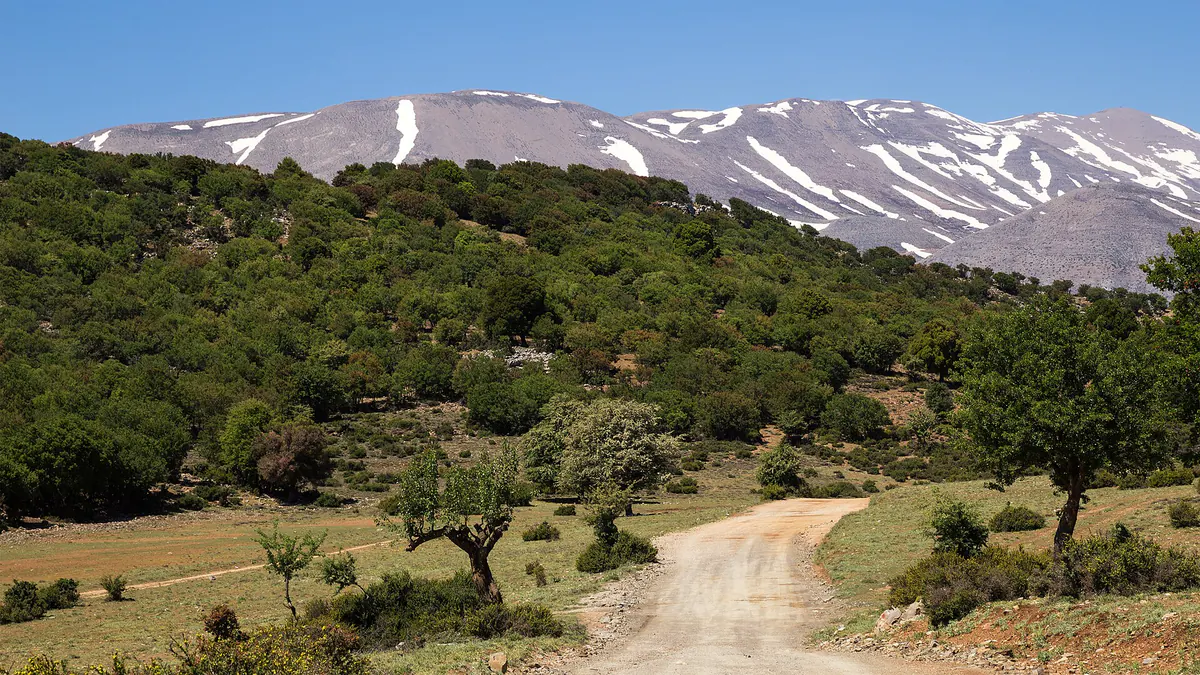
Three mountain ranges dominate the landscape: the White Mountains in the west, Mount Ida at the center, and the Dikti range in the east. These are not gentle hills. They rise steeply from the coast, cutting the island into gorges, plateaus, and isolated valleys that have long kept communities and dialects distinct. The White Mountains, or Lefka Ori, hold snow into late spring and contain the Samaria Gorge, the island's most famous natural feature. Mount Ida, which Cretans call Psiloritis, is the highest peak and, in mythology, the birthplace of Zeus.
The mountains also explain the climate. Northern slopes get more rain and carry denser vegetation: cypress, pine, chestnut, plane trees. Southern slopes are drier and warmer, with maquis, carob, and prickly pear covering the hillsides. Snow stays on the highest peaks until May; summer temperatures on the coast regularly pass 35 degrees Celsius. The meltemi wind, a dry northerly that sweeps down the Aegean in summer, can make the north coast refreshing or punishing depending on the day and the beach. It does not check your beach plans first.
Population & Settlement
Approximately 620,000 people live on Crete, nearly half of them in and around Heraklion, the capital. The other major cities (Chania, Rethymno, and Agios Nikolaos) serve as regional centers, each with its own administrative role and its own identity. Heraklion is the engine: the port, the airport, the university, the largest hospital. Chania is the looker, with its Venetian harbor and centuries of architecture stacked on top of each other. Rethymno sits between the two, quieter than both, with a well-preserved old town and working farmland behind it. Agios Nikolaos in the east serves Mirabello Bay and the resort coast beyond.
Beyond the cities, the island is dotted with villages of every size, some busy and some fading. Some still live from farming; others have become seasonal, home mainly to elderly residents or summer returnees. This shift, common across rural Greece, is especially visible in the mountain villages of the interior, where abandoned terraces still trace the hillsides above streets that once held bakeries, schools, and kafeneia. The villages that hold together (places like Krasi, Anogeia, and Archanes) are not accidents. They have something worth staying for: a working economy, and a cultural identity that young people still recognize as their own.
Economy & Agriculture
Tourism dominates the modern economy, accounting for a significant share of jobs and income. That brings benefits and distortions alike: it pulls workers away from traditional work and builds infrastructure that mainly serves visitors. The coastal strip from Heraklion east toward Malia and on to Agios Nikolaos has been reshaped most dramatically, with resort development that can feel cut off from the island behind it.
Agriculture still matters, above all olive oil. Crete produces some of the highest-quality olive oil in Greece, though much of it is exported in bulk rather than sold under local brands, a long-running weakness. Koroneiki, a variety widely grown on Crete, gives a green, peppery oil that tastes, to me, like the Cretan table. Wine, honey, and dairy products (especially the soft cheese called mizithra and the hard graviera) feed a food culture that remains distinctly Cretan despite outside pressures. The island's farming calendar still shapes daily life: the olive harvest in November and December, wild greens in spring, the grape harvest in September, cheese-making through the milking season. My working life still runs on quarterly deadlines. This is the calendar I'd rather keep.
Language & Identity
Cretans speak Greek, but with regional variations that can puzzle mainlanders. Certain words, pronunciations, and expressions survive from earlier periods, reflecting the island's relative isolation and its people's strong sense of local identity. The Cretan dialect keeps vocabulary from Venetian and Ottoman rule, and some verb forms and intonations are distinctly island-born. Any Greek speaker recognizes a Cretan accent at once.
This identity is not only a matter of language. Cretans often set themselves apart from other Greeks, pointing to their island's distinct history, their resistance to foreign occupation, and their cultural traditions, particularly music, dance, and customs of hospitality that remain more alive here than in much of Greece. The lyra, a three-stringed bowed instrument, and the mantinada, an improvised rhyming couplet, are living traditions, not museum pieces. They are performed at baptisms, weddings, and village feasts, and they belong to a culture that has taken in centuries of outside influence and stayed itself. To understand Crete is to understand that Cretans consider themselves Cretan first. Of everything my wife's island has taught me, that is the lesson I'd pass on before any other.
Editorial note
I combine firsthand observation with research from public and official sources. I check practical details against the sources listed on each guide where they are available, and my recommendations stay independent of paid promotion. For how I approach planning and selection, see my editorial manifesto.
Written by Leo Novak.