A Short History That Matters
The periods that shaped the island's present
Crete's history reaches back more than five thousand years, through great achievements and long stretches of foreign rule. Not all of it helps you understand the island today, so I've put the weight on the periods you can still see: in the landscape, in the culture, and in how Crete lives now. I'm not a historian. I'm a foreigner who wanted to understand my wife's island, and this is the history I found I actually needed.
The Minoan Period
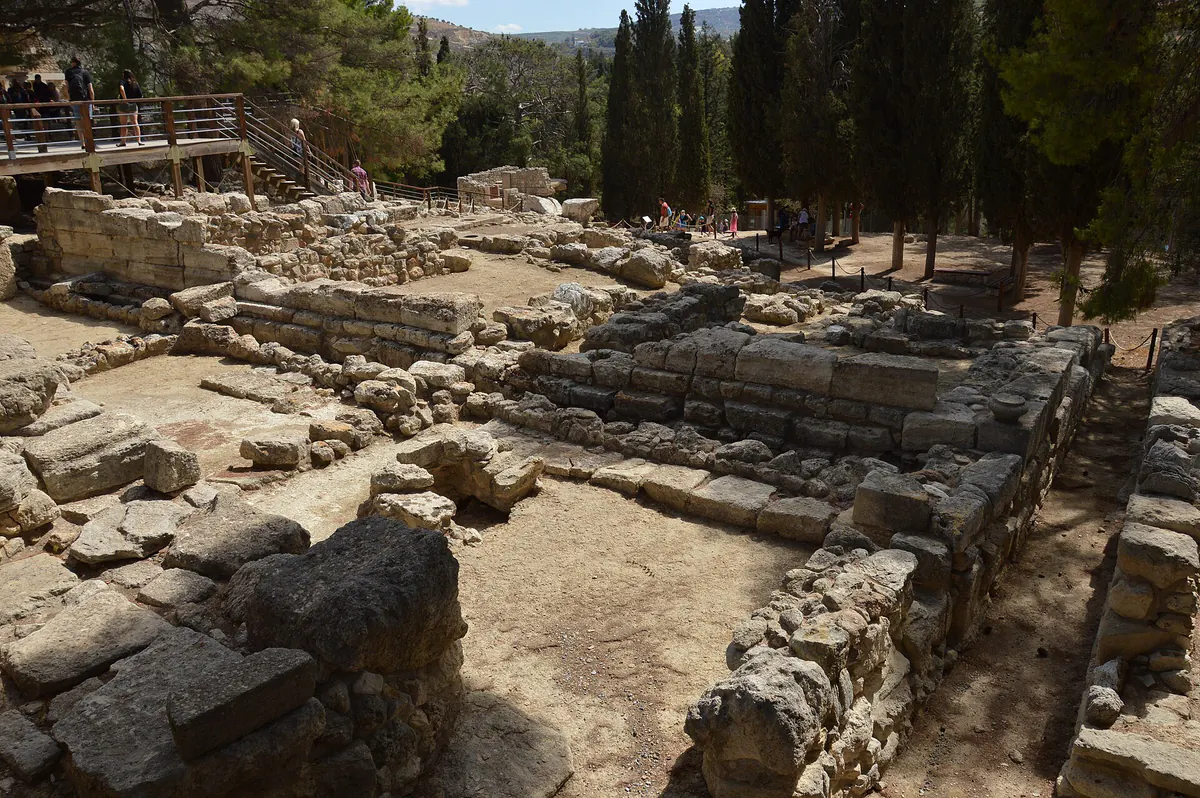
Between approximately 2700 and 1450 BCE, Crete was the center of the first advanced civilization in Europe. The Minoans built elaborate palace complexes at Knossos, Phaistos, Malia, and Zakros: administrative and ceremonial centers that ran a sophisticated economy based on farming, craftsmanship, and sea trade.
The Minoans developed a script, Linear A, still undeciphered (Linear B, adapted from it to write Greek, belongs to the later Mycenaean administration), created a distinctive art full of natural forms and movement, and built trade networks reaching Egypt, the Levant, and the Aegean islands. Their civilization collapsed around 1450 BCE, probably through a combination of natural disaster and Mycenaean invasion.
The Minoan legacy lives on in archaeology and mythology. Knossos remains the island's most visited site, and Minoan motifs (the double axe, the bull, the snake goddess) have become symbols of Cretan identity, reproduced on everything from local crafts to fridge magnets.
Roman Crete
Roman rule moved the island's public center south to Gortyna, capital of the province of Crete and Cyrene. The law-code wall, the Odeion, the Praetorium, and the early Christian remains make the Messara plain a must if you want ancient Crete beyond the Minoan palaces.
Byzantine Crete
After centuries of relative obscurity, Crete became a Byzantine province in 395 CE. This period established Orthodox Christianity as the island's dominant religion and laid the foundations for its church architecture: the small whitewashed churches dotting the landscape that still define rural Crete.
Byzantine rule was interrupted by an Arab conquest in 824 CE. For over a century, Crete served as a base for Arab pirates who raided across the Aegean. The Byzantines retook the island in 961 CE and ruled until 1204, when the Fourth Crusade broke up the Byzantine Empire.
Venetian Rule
Venice acquired Crete after the Fourth Crusade and ruled the island for over four centuries (1204–1669). This period left the most visible architectural legacy: the fortified harbors of Heraklion and Chania, the fortress at Rethymno, the walls around the major cities, and many public buildings, fountains, and loggie.
Venetian rule was not gentle. Cretans were kept under a colonial administration that took the farm surplus and restricted Orthodox religious practice. Yet the same centuries also produced the Cretan Renaissance, in painting (El Greco, born Domenikos Theotokopoulos in Heraklion, is the name most people know) and in literature.
Ottoman Rule
The Ottoman conquest of Crete was gradual and violent. Chania fell in 1645, Rethymno in 1646, and Heraklion in 1669 after a 21-year siege, often counted among the longest recorded in history. Ottoman rule lasted until 1898, though with significant internal resistance.
The Ottoman period left fewer architectural monuments than the Venetian, though mosques, fountains, and some houses survive. More important for today, it shaped who lived where, who owned the land, and how communities were organized, with effects that lasted well into the twentieth century.
Autonomy & Union with Greece
Crete gained autonomy in 1898, under the protection of the Great Powers, after a series of revolts against Ottoman rule. The island formally joined Greece in 1913, completing a union that Cretan nationalists had worked toward for decades.
The Second World War
The Battle of Crete in May 1941 is widely described as the first large-scale airborne invasion. German paratroopers took the island after fierce resistance from British, Commonwealth, and Greek forces, supported by armed civilians.
The occupation that followed was brutal. Reprisal massacres devastated entire villages, and the resistance movement, though active, provoked collective punishment. The war's legacy is still present in memorial sites across the island (the war cemeteries at Souda Bay and Maleme keep their own visiting hours and access details) and in the memories of older Cretans.
Postwar Development
The decades after the war brought emigration, urbanization, and eventually tourism. Villages emptied as people went looking for work in Heraklion, Athens, or abroad. Mass tourism, from the 1970s onward, transformed the northern coast, creating a new economy and new ways of using the land that are still changing.
Where to encounter this history
Almost every layer above can still be visited, each with its own access, hours, and fees. For the Minoan world, I'd start with Knossos and the Heraklion Archaeological Museum, then Phaistos and Zakros in the south and east. Venetian and Ottoman Crete is easiest to see in the harbors and old towns of Chania and Rethymno, and on the island fortress of Spinalonga; the 1866 revolt is remembered at Arkadi. The twentieth-century war is marked at the Souda Bay and Maleme war cemeteries. Check each site's own page for current hours, fees, and transport before you build a day around it.
Editorial note
I combine firsthand observation with research from public and official sources. I check practical details against the sources listed on each guide where they are available, and my recommendations stay independent of paid promotion. For how I approach planning and selection, see my editorial manifesto.
Written by Leo Novak.