South coast ferries
Inter-Crete Ferries And South-Coast Boats
How to read the south-coast boats before you build a Crete itinerary around Loutro, Agia Roumeli, Sougia, Paleochora, or Gavdos.
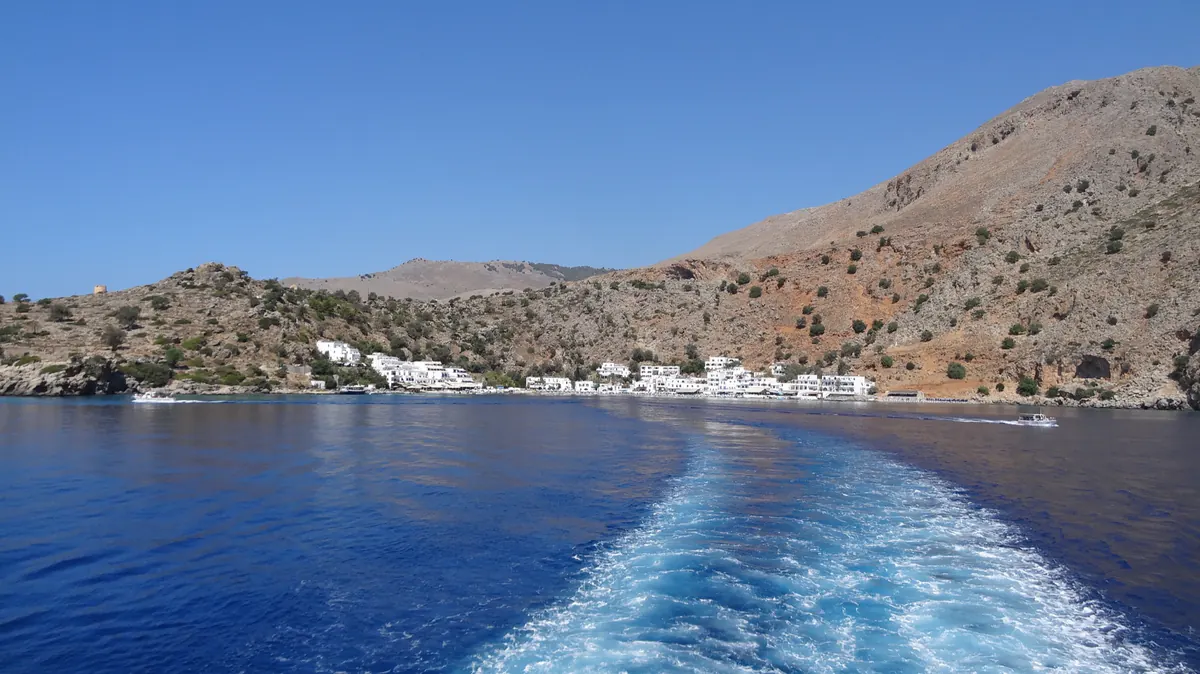
The south-coast ferries are what tie Loutro, Agia Roumeli, Sougia, Paleochora, Chora Sfakion, and Gavdos together. Treat them as a timetable first and a scenic boat ride second.
ANENDYK's current network links the places where the roads end with the villages that have no road at all, along southwest Crete. The question I'd ask isn't whether a boat exists, but whether the exact sailing, bus connection, weather, and ticket rule work for your date.
Quick answer
Read the south-coast boats by date band, direction, and onward bus connection. The main line runs Chora Sfakion, Loutro, Agia Roumeli, Sougia, and Paleochora, with Gavdos as a separate island trip.
Use the route for a simple Loutro day, a west-to-east move along the coast, the ferry half of a Samaria exit, or a planned Gavdos crossing. Don't treat it as an all-day hop-on, hop-off line unless the current timetable shows you a way back.
What the south-coast boats actually connect
The main chain is Chora Sfakion, Loutro, Agia Roumeli, Sougia, and Paleochora, with Gavdos as a separate island add-on. ANENDYK lists all six as served destinations, and its 2026 timetable arranges them in seasonal date bands.
In July and August there are more sailings; by late September and October the same ports may still appear, but with fewer date bands, fewer vehicle options, or different routes. Chora Sfakion is where the road reaches the coast in the east. Paleochora and Sougia are the road-linked ends in the west.
The roadless stops: Loutro and Agia Roumeli
Loutro and Agia Roumeli are the two stops that change how you plan. You can't drive through them, stop for half an hour, and carry on along the coast. Once you're there, you're there, and honestly, I find that half the appeal.
Loutro has no road network, as ANENDYK states on its Loutro page; access is by ferry from Chora Sfakion, Agia Roumeli, Sougia, or Paleochora, or by walking the E4. ANENDYK says the same roadless logic applies to Agia Roumeli, with ferry access or foot access through Samaria and the E4.
For an easy day, Chora Sfakion to Loutro is the simplest south-coast boat trip I know. For a bigger plan, Sougia, Agia Roumeli, and Paleochora bring timing into it: the useful sailings may be one out in the morning and one back in the afternoon, and missing the return can mean sleeping where you land.
How to use the 2026 timetable
I read ANENDYK's timetable in three passes: date band, direction, and whether you have to change boats. Some through routes between Paleochora, Sougia, Agia Roumeli, Loutro, and Chora Sfakion are listed with a change at Agia Roumeli.
Examples I checked on 2026-07-14 include Paleochora-Sougia-Agia Roumeli morning sailings around 08:30 in the main summer and autumn bands, Agia Roumeli-Sougia afternoon returns around 17:30, and Chora Sfakion-Gavdos departures that change by date band. That was one day's check; confirm the current band before you count on it.
Keep the live ANENDYK route table open next to your plan as you build it. South-coast sailings can change with the season, maintenance, demand, and the weather on the Libyan Sea. The sea does not read the timetable.
Gavdos is a different commitment
Gavdos is not one more beach stop. It's a sea crossing to another island, south of Crete, and I'd check how the boats come back before treating the outward ticket as a day trip.
ANENDYK's 2026 timetable, checked on 2026-07-14, shows Gavdos services in date bands from Chora Sfakion and Paleochora, including some routings through Agia Roumeli or Loutro and some vehicle-only notes. ANENDYK's Gavdos page says tickets to and from Gavdos are not available online; vehicle-space reservations require contacting the company office, while foot passengers may buy locally up to one hour before departure.
Don't make Gavdos a casual last-day excursion unless the return sailing, the road transfer, and a backup place to sleep are all sorted.
Bus links that matter
I won't pretend the boat solves the whole day. It often starts or ends with a KTEL bus, especially from Chania to Paleochora, Chora Sfakion, or the Samaria return points.
KTEL Chania-Rethymno's popular-destinations page, checked on 2026-07-14, lists Chania-Paleochora buses Monday-Saturday at 08:45, 10:45, 12:45, and 16:00; Sunday at 08:45, 12:45, and 16:00; Paleochora-Chania Monday-Saturday at 07:30, 11:00, 15:30, and 18:15; and Sunday at 11:00, 15:30, and 18:15.
KTEL's Samaria page, checked on 2026-07-14, states that return buses from Chora Sfakion to Chania and Sougia to Chania run after the ferry from Agia Roumeli, listing Chora Sfakion-Chania every day at 18:30 after ferry arrival and Sougia-Chania every day at 18:15 after ferry arrival. The full Samaria plan is on my Samaria Gorge day logistics page; this page is for the wider boat network.
Best uses for the south-coast ferry network
Use the ferries for an easy Loutro day from Chora Sfakion, a Paleochora-Sougia-Agia Roumeli trip along the coast, a Samaria exit when the park and the boat line up, or a planned Gavdos crossing. These are good plans once you've checked every leg.
Be careful with same-day hopping across too many ports. One more port is the vacation version of one more meeting. On the map the line looks continuous; in the timetable it may be a one-way day with a late return.
The cleanest itineraries usually stick to one anchor: Chora Sfakion for Loutro and the eastern end, Paleochora or Sougia for the western chain, and a separate plan for Gavdos. Use South Coast Crete Bases before you turn a ferry idea into a place to stay.
What to check before you commit
Check ANENDYK for the exact date band, route direction, starred notes, vehicle notes, and any required boat change. For Gavdos with a car, contact ANENDYK before assuming vehicle space.
Check KTEL for the bus leg on the same date, especially if the plan starts in Chania or depends on a bus that waits for the ferry. Then check the weather and the sea close to departure; the exposed south coast forgives wishful scheduling less than a north-coast city day does.
If your plan depends on the last ferry, keep the evening free. That margin is the price of a coast where the sea is part of the road network, and I think it's a fair one.
Practical questions
Can you visit Loutro without a car?
Yes, you don't need one. Loutro has no road network, and ANENDYK connects it by ferry with Chora Sfakion, Agia Roumeli, Sougia, and Paleochora. Most visitors take the boat or walk the E4.
Is Agia Roumeli connected by road?
No. ANENDYK states that Agia Roumeli has no road network. Usually you arrive by ferry from Chora Sfakion, Loutro, Sougia, or Paleochora, or on foot through Samaria or along the E4.
Can you take a ferry from Paleochora to Sougia or Agia Roumeli?
Yes, in the operating season. ANENDYK's 2026 timetable lists Paleochora-Sougia-Agia Roumeli services in summer and autumn date bands, but I'd check the exact sailings for your date.
How do you get to Gavdos from Crete?
By ferry: ANENDYK runs Gavdos services from the south coast of Crete in seasonal date bands, including from Chora Sfakion and Paleochora. Check the current timetable, and if you're taking a vehicle, reserve space through ANENDYK.
Should I buy south-coast ferry tickets online?
Check ANENDYK first. Its Gavdos page says Gavdos tickets aren't sold online, vehicle reservations go through the company office, and foot passengers can buy locally up to one hour before departure.
Sources checked
I checked these on 2026-07-14. Timetables, date bands, route notes, vehicle space, bus departures, and weather decisions can change; check the live operator pages before you travel.
Editorial note
I combine firsthand observation with research from public and official sources. I check practical details against the sources listed on each guide where they are available, and my recommendations stay independent of paid promotion. For how I approach planning and selection, see my editorial manifesto.
Written by Leo Novak.
Related reads
The Guide 2026
My guide for this year: where to go, how to get around, and what’s worth knowing before you do.
Explore the guide